
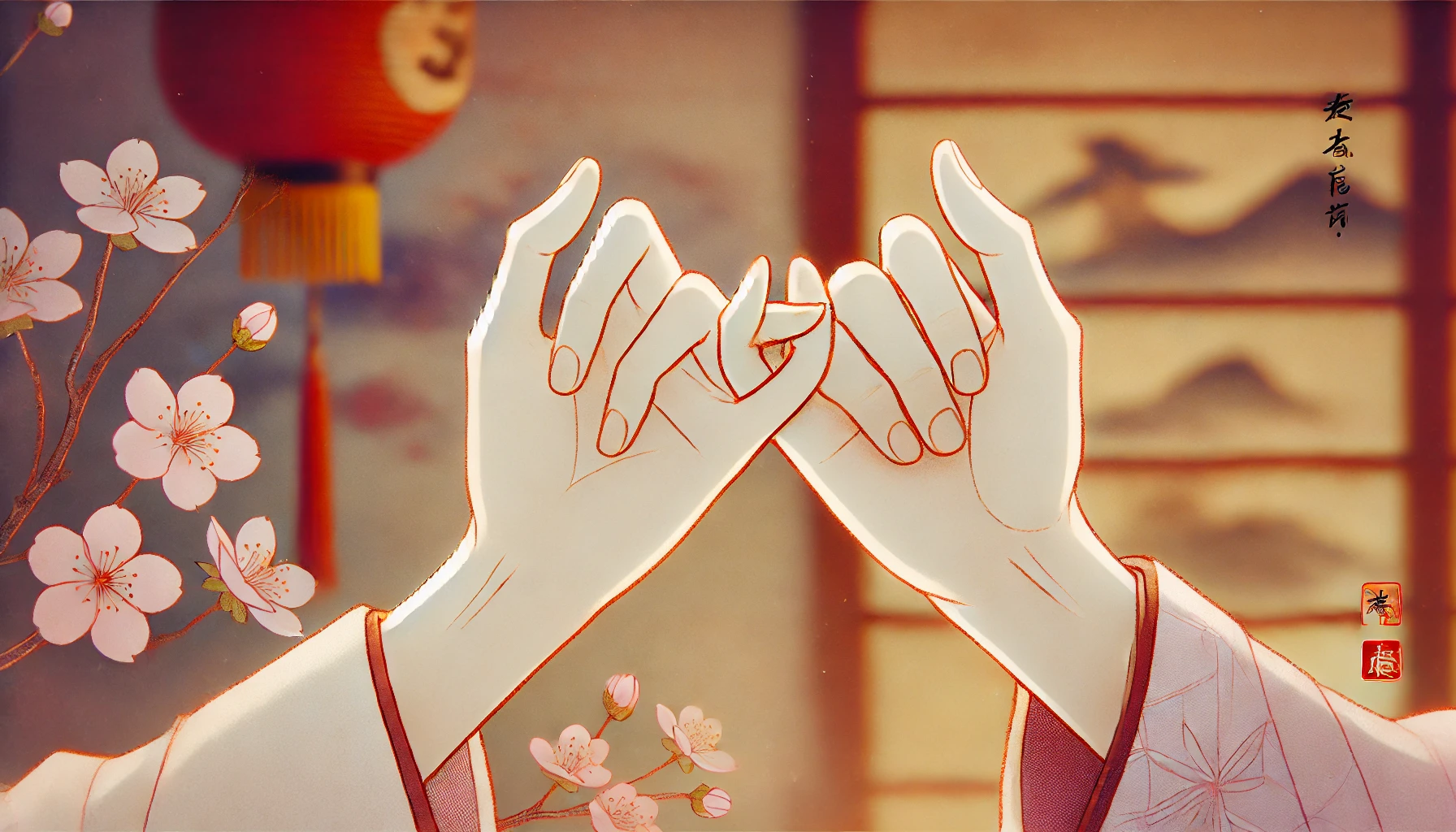
Yubikiri Genman is a tradition deeply rooted in Japanese culture, in which two people intertwine their pinky fingers and make a solemn promise. Along with the gesture, a ritualistic phrase is recited: "Yubikiri Genman, uso tsuitara hari senbon nomasu," which translates as "Pinky promise, if you lie, you will swallow a thousand needles." Although this punishment is merely symbolic, the practice conveys the seriousness and commitment to honoring one's word.
Beyond Japan, similar practices involving promises and the gesture of fingers can be found in other cultures, such as the "pinky swear" in the United States, reflecting how the value of trust is universal. Next, we will explore the meaning of Yubikiri, its historical origins, and what to do if a promise made with the pinky needs to be undone.
Contents 13
The Meaning Behind Yubikiri
Yubikiri is not just a symbolic gesture, but a reflection of the seriousness with which a promise is regarded. The word carries a clear message: fulfilling what is promised is an act of honor and commitment.
The Word and the Ritual
In Japanese, "Yubikiri" literally means "finger cut," while "Genman" refers to an exaggerated punishment — in this case, the threat of swallowing a thousand needles and also cutting off a finger. The word does not refer to a real act, but rather to an enchantment that intensifies the promise, adding an element of seriousness to the commitment made. The complete expression communicates the idea that betraying the promise will have severe consequences, even if only in the symbolic realm.
Trust and Seriousness
This gesture is often used by children and young people as a playful way to ensure agreements or secrets. However, the implicit value is profound: honoring one's word. In Japan, trust is an essential foundation for relationships, and Yubikiri reflects this importance. It reminds us that every promise, no matter how small, must be fulfilled with integrity.
Regionalisms and Variations
Although the most well-known expression is "Yubikiri Genman," there are regional variations of the promise. In Tokyo, for example, the local version is: "Yubikiri, kamakiri, uso iu mono wa jigoku no kama e pottari sho" (If you lie, you will fall into the cauldron of hell). These variations show how the tradition has been adapted in different parts of Japan, while still maintaining the essence of the commitment.
The Historical Origin of Yubikiri
Although today Yubikiri is a cherished tradition, its historical roots trace back to much harsher practices. The gesture has evolved over the centuries, passing through punitive contexts and rituals of love, until it became the symbol we know today.
From Feudal Times to Current Symbolism
The gesture of Yubikiri may have origins linked to ancient legal and punitive practices. During the Kamakura and Edo periods, there was a practice of amputating fingers as punishment for criminals or as a form of restitution. In parallel, among groups of gangsters (the yakuza), cutting off the pinky was a way to demonstrate remorse and submission, a tradition that survived as an internal punishment in the criminal underworld.
Yubikiri and Courtesans
During the Edo period, some courtesans would cut their hair or offer a piece of their pinky as proof of love and fidelity to a beloved client. These extreme gestures of devotion were seen as a form of "sentimental contract," sealing a deep bond. Over time, the tradition of Yubikiri evolved into a more symbolic act, appropriated by children and young people.
Global Cultural Differences
Interestingly, similar practices have emerged in other parts of the world. In the United States, the expression "pinky swear" appeared in the 19th century, meaning a serious promise made with the pinky. In Vietnam, instead of the pinky, people use their index finger to seal their agreements. These similarities reinforce how the act of promising is an essential human behavior, present in different cultures.

How to Undo a Pinky Promise
Undoing a promise can be as challenging as making one. However, recognizing limitations and knowing how to apologize is essential to preserving trust and relationships.
The Difficulty of Breaking a Promise
Once made, a promise sealed with the pinky carries significant weight. In some traditions, breaking the vow is seen as a personal failure that can weaken trust between the parties. However, life is not always predictable, and situations may arise where it is impossible to fulfill what was promised.
The Art of Apologizing
If a promise needs to be broken, it is essential to communicate this clearly and honestly. In Japan, sincere apologies are an act of respect and are widely accepted as a way to repair mistakes. Thus, undoing a pinky promise should involve an explanation and an apology, reinforcing the intention to maintain trust.
Steps to Undo a Promise:
- Acknowledge the mistake: Admitting that you cannot fulfill what was promised is the first step.
- Communicate in advance: Avoid letting the other person find out on their own.
- Offer compensation: If possible, propose an alternative solution.
The Value of a Fresh Start
Breaking a promise does not have to mean the end of a trusting relationship. In fact, dealing with the mistake maturely can further strengthen the bond between the parties. The important thing is to act with transparency and avoid making promises that cannot be kept in the future. As the Japanese proverb says: "Seven falls, eight rises" – life is about starting over and continuing to try.
Conclusion
The tradition of Yubikiri Genman offers a deep reflection on the value of promises and trust in relationships. Although often viewed lightly and playfully, the practice teaches us that words have power and that honoring a commitment is an act of respect and nobility. In a world where trust is increasingly rare, perhaps it is time to rediscover the value of a simple yet sincere promise – even if made with a small gesture of intertwined pinkies.




Community
Comments
0 comments
There are no published comments in this language yet.
Send comment