
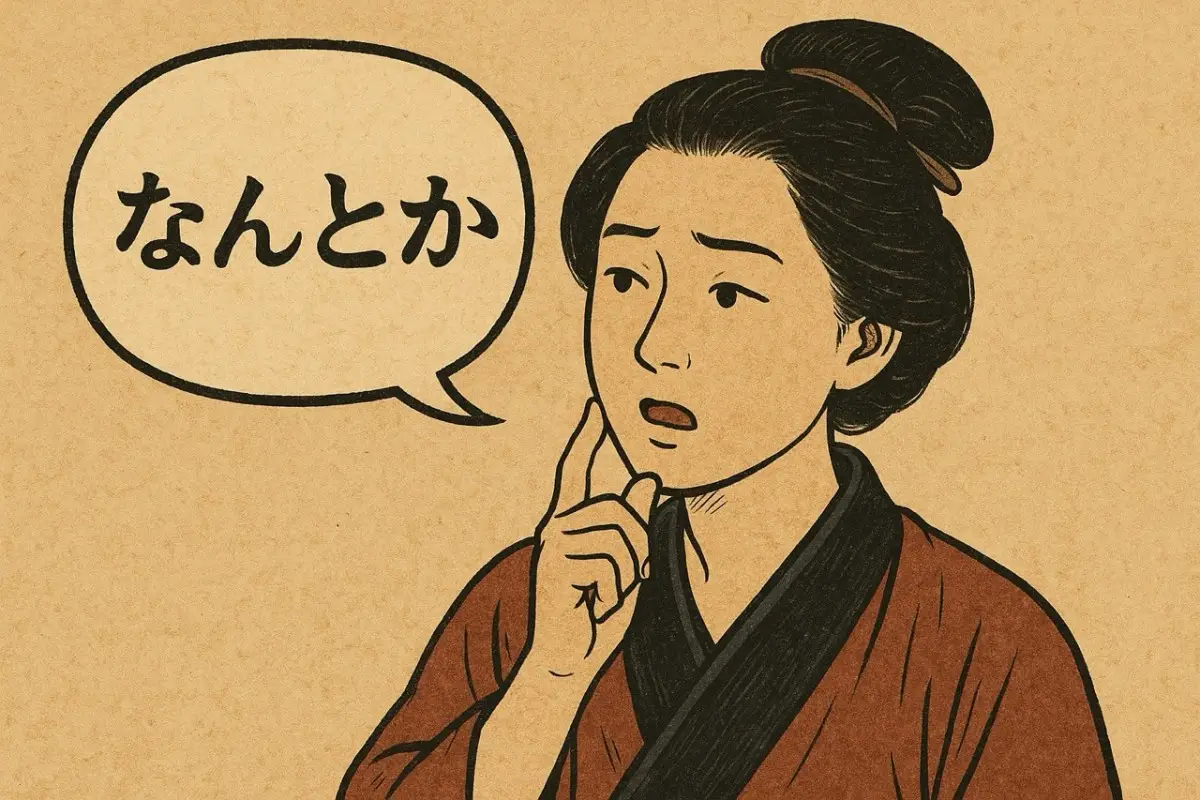
When learning Japanese, there are certain expressions that appear everywhere — in informal conversations, news reports, manga, and even serious speeches. One of them is なんとか (nantoka). At first glance, it seems just like another one of those vague little words that the Japanese love, but in practice, it carries a versatile and cultural weight that deserves attention.
Have you ever tried to remember someone's name and said “uh... that person, I don't know...”? Or tried to explain that you found a way to resolve something even without knowing exactly how? In Japanese, なんとか (nantoka) fills precisely those gaps in language — when precision is lacking, context prevails.
In this article, we will understand what nantoka means, how and when to use it, explore variations and related expressions, as well as analyze its role in Japanese communication. And don't worry: we will bring everything with romaji, kanji when appropriate, and accessible explanations, as if we were chatting about Japanese in a Tokyo café.
Read in our dictionary: Nantoka [なんとか]
Contents 8
What does なんとか (nantoka) mean?
Directly, なんとか can be translated as:
- “Somehow”
- “In some way”
- “Something like that”
- “I don't know” (in a casual tone)
The word comes from 何とか where:
- 何 (nani) = “what”
- とか = a particle that can imply “things like” or “etc.”
When combined, they create a vague, useful, and highly adaptable meaning.
See some examples to understand better:
なんとかなるよ。
(Nantoka naru yo)
“It will work out somehow.”
彼の名前、なんとか田中だったかな。
(Kare no namae, nantoka Tanaka datta kana)
“His name was something Tanaka, I think.”
This flexibility makes なんとか function almost like a "linguistic wildcard": it fills gaps when speech needs to be fluid, but without precision.
Situations where なんとか appears naturally
You will see and hear nantoka in various everyday situations. Below, we highlight the most common contexts and how to identify them.
1. When finding an improvised solution
Imagine you had a problem at work, but managed to get around the situation, even if you didn't know exactly how.
なんとか修理できました。
(Nantoka shuuri dekimashita)
“I managed to fix it somehow.”
Here, nantoka expresses effort, resilience, and result, even in the face of uncertainty.
2. When not remembering something exactly
It is very common to use なんとか to express imprecision of memory, especially with names, places, or specific terms:
あのレストラン、なんとか屋だったよね?
(Ano resutoran, nantoka-ya datta yo ne?)
“That restaurant, it was something-ya, right?”
This informal use shows how Japanese can keep the dialogue flowing even without exact information.
3. In a tone of motivation or hope
It is often used in phrases like:
なんとかなるさ。
Nantokanarusa
“It will work out.”
Here, nantoka carries not only the literal sense of "somehow," but also an emotional value — a serene hope, typical of Japanese culture to avoid direct confrontations or pessimism.
Similar words and expressions
There are other expressions that may confuse or seem equivalent, but have different nuances:
- なんとなく (nantonaku) – “for some reason,” “without a specific reason”なんとなく悲しい。 (I feel sad, not sure why.)
- なんでも (nandemo) – “anything”なんでもいいよ。 (Anything works.)
- どうにか (dounika) – Also means “somehow,” but is a bit more desperate or formal than nantoka.
- なんか (nanka) – Informal and used for emphasis or disdain.なんか変だね。 (It's kind of strange, right?)
While nantoka is versatile and almost neutral, these other words can carry different intentions. Using the correct one at the right moment is part of mastering everyday Japanese.
How to use なんとか naturally
To incorporate nantoka into your active vocabulary, the secret is to observe and practice with real sentences. Here are some practical tips:
- Watch subtitled doramas and animes: It's one of the most natural ways to perceive the tone and context of use.
- Use as a temporary substitute in sentences during speech, just like we do with “I don't know” or “something.”
- Combine with flexible verbs like なる (naru – to become), できる (dekiru – to manage), or がんばる (ganbaru – to strive).
Useful phrases to practice:
- なんとかしなきゃ! (I have to figure it out!)
- なんとか言ってよ。 (Say something, come on.)
- この問題、なんとかならない? (Isn't there a way to solve this somehow?)
Conclusion
The word なんとか (nantoka) is a great example of how Japanese conveys complex ideas and subtle emotions with simple and flexible expressions. It may seem vague at first glance, but when used correctly, it conveys exactly what the speaker wants — even if it is undefined.
Learning to use nantoka naturally is like learning to dance: it requires practice, observation, and a bit of intuition. But once you master it, your communication becomes more fluid, engaging, and much more authentic.
If you still feel unsure about using it, that's okay — なんとかなるよ!




Community
Comments
0 comments
There are no published comments in this language yet.
Send comment