
Today, with the vast range of stories created in the anime industry, we find series that explore every corner of human curiosity. In this article, we look at a particularly engaging approach: anime built around principles of physics and chemistry. Certain creators anchor their fictional worlds in real physical laws, giving weight and credibility to every battle and superpower. We will examine three specific series: Fullmetal Alchemist, Boku no Hero Academia, and Aldnoah.Zero.
This article was submitted through our form by someone nicknamed Naruto Olavo. Thank you very much to the author of the article; we reviewed the original ideas and added extra scientific context for the reader. I hope everyone enjoys this exploration of science in anime.
Contents 5
Fullmetal Alchemist: Alchemy and the Conservation of Mass
Synopsis: Fullmetal Alchemist is one of the most celebrated anime of all time, featuring two animated adaptations, including the 64-episode masterpiece Fullmetal Alchemist: Brotherhood. The story follows brothers Edward and Alphonse Elric, who lose their mother to illness and attempt to resurrect her using forbidden alchemy. The transmutation fails disastrously: Edward loses his left leg and right arm, while Alphonse loses his entire physical body, with his soul bound to an antique suit of armor. Together, they embark on a continent-spanning journey to find the Philosopher's Stone and restore their bodies, only to uncover a deep military conspiracy threatening their entire nation.

The central discipline in Fullmetal Alchemist is alchemy, the historical predecessor of modern chemistry. In the ancient civilizations of Mesopotamia, Egypt, and Greece, alchemy was a fusion of early metallurgy, natural philosophy, and mysticism. Early alchemists pursued two legendary goals: the transmutation of base metals into gold and the creation of the Philosopher's Stone, an elixir granting longevity or artificial life. Because ancient alchemy relied on hermetic, closely guarded secrets, it eventually gave way to modern chemistry, where empirical data and peer validation are accessible to all.
In the world of the Elric brothers, alchemy is governed by the Law of Equivalent Exchange: to obtain something, something of equal value must be given in return. In physical terms, this fictional law reflects the fundamental principle formulated in 1789 by French chemist Antoine de Lavoisier: the Law of Conservation of Mass. Lavoisier established that in any closed system, mass is neither created nor destroyed; all matter merely changes form. Edward and Alphonse operate under strict material limits: transmuting a stone wall or shaping a blade requires reshaping the pre-existing elemental compounds present in the earth. Their tragic childhood experiment failed because they attempted to calculate a human soul through mere chemical elements, discovering that nature demands an exact physical and spiritual balance.
My Hero Academia: Quirks, Thermodynamics, and Gas Expansion
Synopsis: My Hero Academia (Boku no Hero Academia) revitalizes the classic superhero genre within a modern shonen framework. In a world where eighty percent of humanity possesses superhuman abilities known as Quirks, Izuku Midoriya is born without any power. After proving his heroic heart, he inherits the legendary One For All from the world's greatest protector, All Might, and enrolls in the elite U.A. High School hero course.
Many of the superpowers in My Hero Academia are grounded in biological and thermodynamic principles. Katsuki Bakugo, for instance, produces a specialized palm sweat chemically akin to nitroglycerin. By activating fine friction sparks across his sweat glands, he triggers controlled detonations. The physical impact of his attacks obeys chemical propulsion: as he exerts more physical effort and sweats heavily, the explosive yield of his detonations increases, allowing him to launch massive shockwaves or ride rapid recoil blasts across the battlefield.
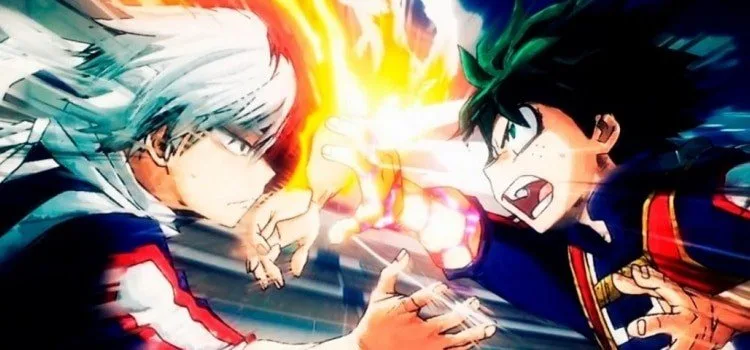
Shoto Todoroki demonstrates an equally intriguing application of thermodynamics with his Half-Cold Half-Hot Quirk. Todoroki creates ice by rapidly absorbing heat from the surrounding environment, lowering ambient temperature until atmospheric moisture condenses and freezes solid. He can then release this accumulated thermal energy through his left side as intense flame. During the climax of his tournament duel against Izuku Midoriya at the U.A. Sports Festival, Todoroki unleashes both halves simultaneously. Teacher Shota Aizawa points out the immediate physical reaction: the chilled air that filled the stadium was instantly superheated by Todoroki's flames. This sudden temperature jump forced the dense air molecules into rapid thermal expansion, generating a violent pressure shockwave that shattered the arena floor.
Aldnoah.Zero: Tactical Logic and Electrical Potential
Synopsis: Aldnoah.Zero chronicles a devastating interplanetary conflict between the inhabitants of Earth and the Vers Empire of Mars, whose aristocratic knights wield formidable Aldnoah technology. The series is particularly renowned for its grand tactical mecha engagements and its memorable musical score composed by Hiroyuki Sawano.
Protagonist Inaho Kaizuka stands out because he lacks the overpowered weaponry of his Martian adversaries. Piloting an orange training model, the KG-6 Sleipnir, Inaho consistently triumphs through calm analytical observation and real-world physics. In one of the most tactical encounters of the series, Inaho faces the Martian Kataphrakt Electris, piloted by Count Zebrin. The Electris envelops itself in a massive static electricity barrier that vaporizes incoming artillery and discharges lethal high-voltage arcs.
Inaho recognizes that electrical current requires a potential difference, so he equalizes the voltage between the two machines to neutralize the barrier. He attacks the Electris while dropping from the air, preventing Earth from acting as an electrical ground. Mid-descent, he fires a conductive tether cable into the Martian mech. With a direct conductive path established, the electric potential between the Sleipnir and the Electris becomes equal. Because electrical current cannot travel between two points possessing the same voltage, the lethal lightning barrier is rendered ineffective, allowing Inaho to deliver a decisive close-range strike.
Other Anime Grounded in Real Science
Beyond these three featured works, many other anime productions across different genres use physics, chemistry, biology, and medicine to construct compelling storylines:
- Dr. Stone: After a mysterious green light petrifies humanity for millennia, high school genius Senku Ishigami uses chemistry, metallurgy, and basic electrical engineering to rebuild civilization step by step.
- Steins;Gate: A suspenseful sci-fi narrative that delves into thermodynamics, Kerr black holes, and the theoretical physics of time travel, making it one of the best time travel anime ever produced.
- Cells at Work! (Hataraku Saibou): An educational and action-packed look at human physiology, personifying red blood cells, white blood cells, and platelets as they combat real antigens, bacteria, and allergens.
- Parallel World Pharmacy (Isekai Yakkyoku): A reincarnated pharmacologist relies on genuine molecular chemistry, pathology, and modern medical hygiene to treat widespread plagues.
- Science Fell in Love, So I Tried to Prove It (Rikekoi): Two university researchers use scientific method, statistical modeling, and experimental trials to quantify whether they are in love.
- Chikyuu Shoujo Arjuna: An ecological series exploring ecosystems, organic farming, soil health, and the balance of natural chemistry on Earth.
- Red Garden: A psychological drama with dark gothic mystery that subtly introduces biological experimentation and medical anomalies into its character dilemmas.
Why Scientific Rules Make Anime Stories Stronger
When anime creators ground their worlds in actual physics and chemistry, the entire narrative gains credibility. Fantastical powers become far more rewarding when heroes cannot rely on convenient plot armor to solve their crises. Knowing that energy must be conserved, that air expands when heated, or that electric currents demand a voltage drop gives viewers a tangible sense of stakes.
Whether in Edward Elric's alchemical transmutations or Inaho Kaizuka's tactical mech maneuvers, science provides an intellectual foundation that makes fictional achievements feel genuinely earned. When a character uses intellect and natural laws to outsmart an opponent, the victory resonates long after the credits roll.





Community
Comments
0 comments
There are no published comments in this language yet.
Send comment