
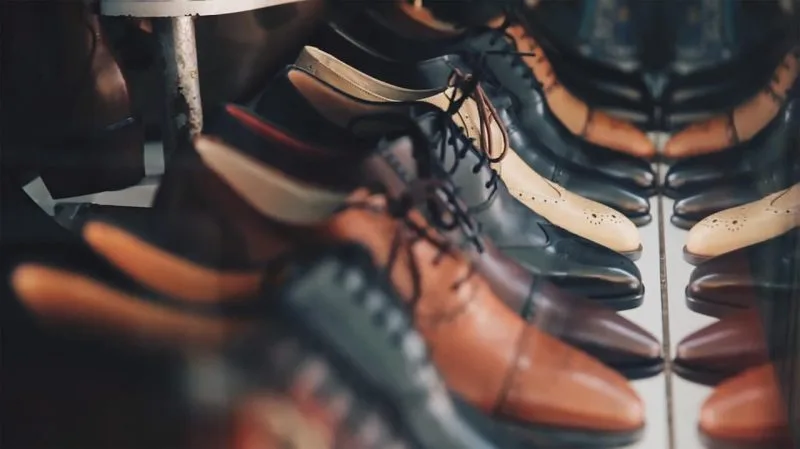
Want to buy sneakers, shoes, and other footwear in Japan, but don't know how to ask, which size to choose, and how to buy them? The number on a Japanese shoe label is the length of the foot in centimeters, and the words and sentences further down are what you use at the shelf and at the counter.
If you are visiting Japan, you can take advantage of the great prices on brand footwear like Mizuno. Just don't think it will be easy; prices tend to vary quite a bit, and you need to do some good research.
From November 2026, a consumption-tax refund on tax-free shoes depends on customs confirmation when you leave. Buy only what you can carry out of Japan yourself. Leave within 90 days of the purchase, show your passport, and finish the confirmation at a terminal in the departure lobby before you hand over checked baggage. If customs asks to see the shoes, you show them. Take the confirmed shoes out of Japan. Otherwise the waived consumption tax is collected and a penalty applies.

Contents 3
Shoe Sizes in Japan
The first thing we need to know when buying footwear in Japan is your correct size. Mondopoint is that same centimeter length written in millimeters: 26.5 cm and 265 mm are one measurement.
ABC-MART measures an adult foot on a hard floor. Stand on the paper with your feet about a shoulder width apart, your weight even on both feet, and your toes straight. They recommend measuring from the evening onward, because feet swell in the afternoon. They also recommend two people, because one person cannot always measure accurately. Line the heel up with a thick book, or with the corner of a wall if you have no book, and mark the longest toe. For the girth, wrap the tape around the ball of the big toe and the ball of the little toe. Left and right feet differ, and so does the hour you measure. The JIS width chart is only a guide, and the same centimeters can feel different by maker and by how snug you like the shoe.
The rows below are ABC-MART's combined men's and women's shoe chart. The Japan column is the centimeter size. Where the USA column prints H, that is a half size: 8H means 8.5. On this chart EU 42 sits at 26.5 cm, and the EU cell at 26.0 cm is blank. Use this chart when the pair is sold on that combined scale. The fit still changes with the maker.
| Japan (cm) | EU | USA |
| 22.5 | 35 | 4H |
| 23.0 | 36 | 5 |
| 23.5 | 37 | 5H |
| 24.0 | 38 | 6 |
| 24.5 | 39 | 6H |
| 25.0 | 40 | 7 |
| 25.5 | 41 | 7H |
| 26.0 | - | 8 |
| 26.5 | 42 | 8H |
| 27.0 | - | 9 |
| 27.5 | 43 | 9H |
| 28.0 | 44 | 10 |
| 28.5 | - | 10H |
| 29.0 | 45 | 11 |
| 29.5 | - | 11H |
| 30.0 | 46 | 12 |
ABC-MART's ladies chart puts the same EU number on a different centimeter. There, EU 42 sits at 26.0 cm. If the box or the shelf is marked for women, use this chart instead of the combined one.
| Japan (cm) | EU | USA |
| 22.0 | 34 | 5 |
| 22.5 | 35 | 5H |
| 23.0 | 36 | 6 |
| 23.5 | 37 | 6H |
| 24.0 | 38 | 7 |
| 24.5 | 39 | 7H |
| 25.0 | 40 | 8 |
| 25.5 | 41 | 8H |
| 26.0 | 42 | 9 |
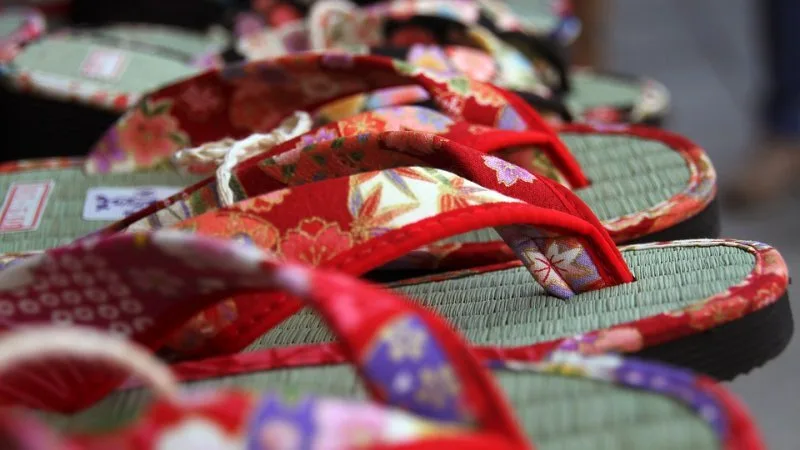
Those sandals are zori: floral fabric straps and woven straw soles. Geta are the wooden sandals.
Types of Footwear in Japanese
The second thing we need to know is the vocabulary of footwear in Japanese so we can research either in a store or on a website like Amazon.jp. Perhaps researching footwear beforehand on Amazon will help you get an idea of the price of certain products, so here's a tip! Now let's list the types of footwear and shoes in Japanese. The columns are English, Japanese, and romaji.
| Sandals | サンダル | sandaru |
| High heels | ハイヒール | haihiiru |
| Shoes | 靴 | kutsu |
| Geta (wooden clogs) | 下駄 | geta |
| Slippers | スリッパ | surippa |
| Boots | ブーツ | buutsu |
| Below-knee boots, often rubber | 長靴 | nagagutsu |
| Socks | 靴下 | kutsushita |
| Indoor school shoes | 上履き | uwabaki |
| Sneakers | スニーカー | suniikaa |
| Mid-shin boots | 半長靴 | hannagagutsu |
| Leather shoes | 革靴 | kawagutsu |
| Rain shoes | 雨靴 | amagutsu |
| Fashion long boots | ロングブーツ | rongubuutsu |
| Climbing boots | 登山靴 | tozangutsu |
| Snow boots | 雪靴 | yukigutsu |
| Men's dress shoes | 紳士靴 | shinshigutsu |
長靴 reaches just below the knee and is often the rubber boot for rain or snow. 雨靴 names rain shoes, and ロングブーツ is the fashion boot.
Phrases Related to Buying Shoes and Footwear in Japan
To conclude the article, we will share some phrases that can help you buy your footwear in Japan. The columns are romaji, Japanese, and English. The [~] is a slot for the word or the centimeter you need.
| Kore wa watashi ni wa ookii kana. | これは私には大きいかな | Is this too big for me? |
| Saizu ga awanai node, torikaete moraemasu ka. | サイズが合わないので、取り替えてもらえますか | The size is wrong, can I exchange it? |
| Kore wa ikura desu ka. | これはいくらですか | How much is this? |
| [~] wa doko ni arimasu ka. | [~]はどこにありますか | Where is the [~]? |
| Miteiru dake desu. | 見ているだけです。 | I'm just looking. |
| Kore ni shimasu. | これにします。 | I'll take this one. |
| Dochira ga ii to omoimasu ka. | どちらがいいと思いますか。 | Which one do you think is better? |
| Watashi wa kutsu wo kaitai desu. | 私は靴を買いたいです。 | I want to buy shoes. |
| Watashi no saizu wa [~] senchi desu. | 私のサイズは[~]センチです。 | My size is [~] centimeters. |
| Kutsu no saizu wa dore kurai desu ka. | 靴のサイズはどれくらいですか | What size are these shoes? |
Regardless of whether you live in Japan or you are only visiting, a good alternative is to shop at the large Japanese Amazon.
If you have any questions or tips, leave your comments. If you liked the article, share it with your friends, thank you, and see you next time!



Community
Comments
0 comments
There are no published comments in this language yet.
Send comment